
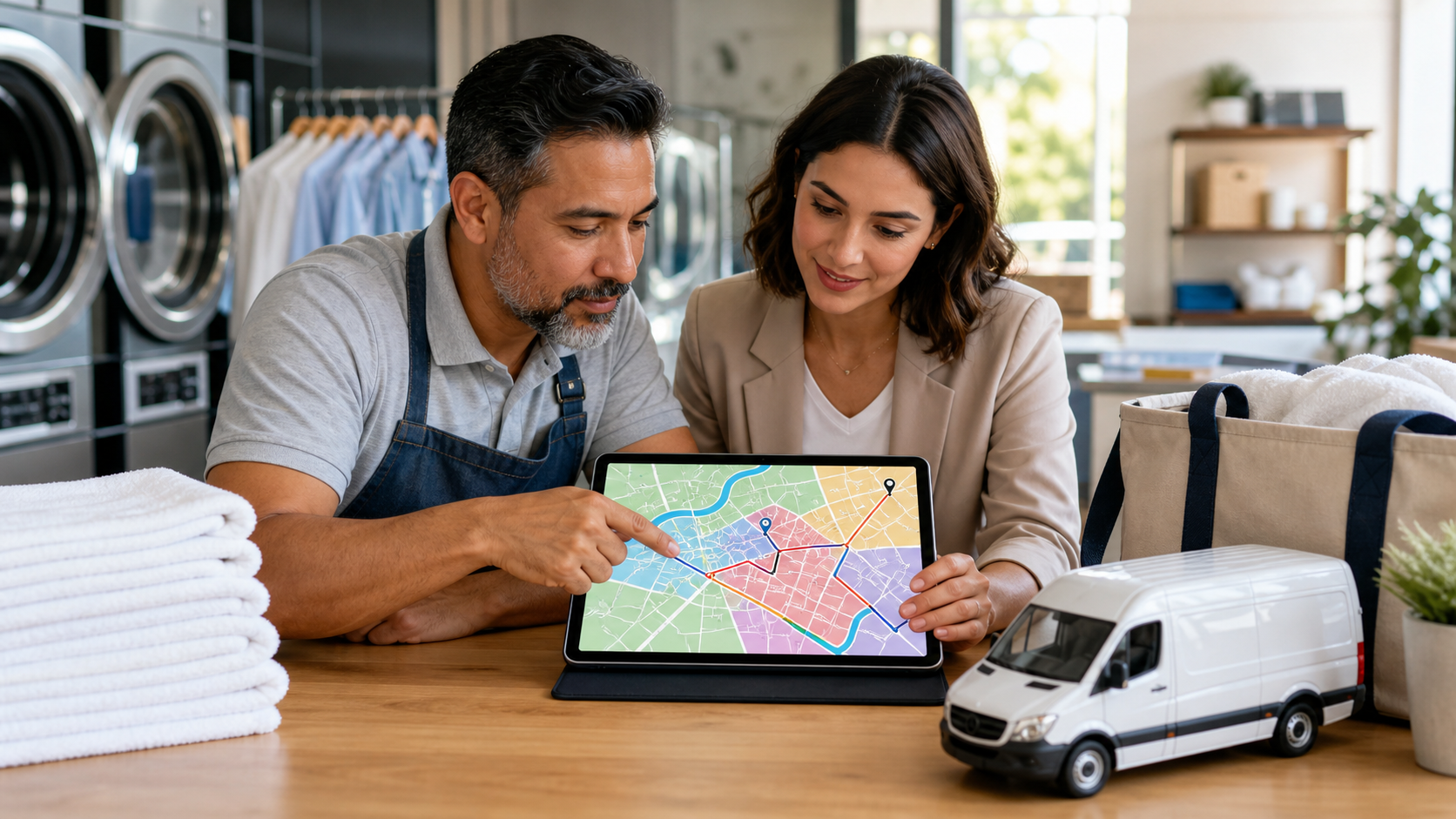
Turn Searchers Into Scheduled Pickups, Not Just Clicks
Strong laundromat local SEO should not just give you more calls; it should give you better routes. A busy Google Business Profile is great, but a packed route in the wrong area can wreck your drivers, your machines, and your customer reviews. The goal is not “more,” the goal is “matches how we actually operate.”
Most advice stops at “rank higher” and “get more leads.” For pickup and delivery, that is only half the job. The other half is how we set service areas, explain pricing by zone, and build landing pages so the orders we attract fit our schedule, staff, and equipment.
As days get shorter and roads get wet or icy, delivery gets harder. Holiday travel, flu season, and bad weather all hit at the same time. This is exactly when we want our pickup demand to match our capacity, not fight it. In this guide, we will walk through how to set smart service areas, build helpful pricing and zone pages, and design routing-friendly landing pages that work with Google Business Profile instead of hurting it.
Design Service Areas That Match Real-World Capacity
Many laundry owners think in miles. “We go 10 miles out.” The problem is that 10 miles downtown is not the same as 10 miles in light traffic. A better way is to think in routes, time, and stops, not circles on a map.
We like an operations-based mindset. That means:
- Zones built around drive time, not distance
- Areas chosen for easy parking and loading
- Order minimums that make a stop worth it
- Hot zones where you want to grow, not just where you technically could go
Start with data you already have. Look at:
- Peak drop-off and pickup hours
- Driver start and end times
- How many pounds you can actually wash and fold in a day
- Where current customers cluster on a map
From there, sketch coverage polygons that feel realistic. Maybe you have a dense “Zone A” close to the store where you want all the growth. Then a “Zone B” a bit farther out, that you only run on certain days. You might have a “Zone C” that you keep limited for now.
On Google Business Profile, keep the center of gravity on your physical location. Use service areas in a simple, honest way. Avoid listing every tiny suburb just to look bigger. Your site content and zone pages can do most of the location work without risky changes to your profile. This keeps you inside guidelines and focused on serving areas that truly fit your operation.
Build Smart Pricing and Zone Pages That Pre-Qualify Orders
Once your zones are clear internally, the next step is to show them clearly on your site. A good zone page should feel like a friendly guide, not a math problem.
A strong zone structure often includes:
- Simple names: Zone A, Zone B, Zone C
- A clean map or list of neighborhoods and ZIPs
- Clear pickup rules by zone, like order minimums and days of service
- Easy to scan tables for pickup fees or surcharges
These pages protect your team. When a customer can see their zone before they book, they know what to expect. They are less likely to ask for a same-day pickup in your farthest area or get upset about a minimum they never saw.
To help these pages pull their weight for laundromat local SEO, give each zone its own unique content. You can:
- Mention local landmarks, big streets, or well-known buildings
- Answer questions that come up in that zone, like high-rises or limited parking
- Spell out turnaround time if a zone is farther and needs an extra day
Link each zone page from your main Pickup and Delivery page so visitors and search engines can find them. You do not need to create dozens of thin pages. A handful of honest, helpful zone pages is enough to make your coverage clear without looking spammy.
Create Routing-Friendly Landing Pages That Dispatchers Love
Now that people know where you go and what it costs, the last step is making it easy to book in a way your dispatch team can actually use. Routing-friendly landing pages close the loop between marketing and operations.
On these pages, we want forms that collect:
- Exact street address and unit number
- Preferred pickup and drop-off windows
- Building access notes, like gate codes or call box details
- Laundry preferences that matter for sorting and labeling
When this data is clean, it can often move right into routing tools with very little manual fixing. That means fewer calls back to the customer and fewer surprises for drivers.
Match these pages to your zones. You can prompt people to confirm their neighborhood or ZIP code, then send them to the right form and pricing. Some tools can auto-detect location, but even a simple “What area are you in?” step helps. It cuts down on bookings from places you no longer serve.
There is always a balance between conversion and SEO. To keep both sides happy:
- Make pages fast on mobile with short forms above the fold
- Use one main call-to-action like “Schedule Pickup”
- Add a small map, trust badges, and a short section of text about how the service works
- Use internal links so search engines understand where pickup content lives on your site
That way, you get a page that books real orders without turning into a slow, cluttered wall of text.
Keep GBP Rankings Safe While Expanding Pickup Demand
Many owners worry that changing service areas or adding zone pages will hurt their Google Business Profile. The good news is that rankings mostly come from proximity, relevance, and prominence, not from how many city names you stuff into your profile.
What to avoid:
- Fake addresses or “virtual” locations
- Huge service area lists that do not match reality
- Dozens of thin doorway pages targeting tiny location phrases
Instead, focus on real-world relevance. Use the same business name, address, and phone number everywhere. List pickup and delivery the same way on your profile and your site. When customers leave reviews, gently guide them to mention the neighborhood or area you served, not just “great pickup.”
Roll changes out in phases. Add one or two new zones, publish the related pages, then watch:
- GBP searches and views
- Direction requests
- Calls and site visits
- Route metrics like stops per run and average drive time
This is how we prove to ourselves that better operations and better SEO do not have to fight. They can grow together if we move carefully.
Turn Your New Structure Into a Winter Growth Sprint
The stretch from late fall into winter is a perfect window to tighten things up. Demand for pickup and delivery tends to rise as weather gets worse and people are home more. Instead of rushing to react, use this time as a simple growth sprint.
A 30-day action plan might look like this:
- Week 1: Map current routes, note capacity, and mark natural hot zones
- Week 2: Set zones and write or refresh pricing and coverage pages
- Week 3: Rebuild or fine-tune routing-friendly booking pages and forms
- Week 4: Watch GBP insights and route data, then adjust zones or copy
When we treat laundromat local SEO as an operations lever, not just a marketing trick, everything lines up. Drivers waste less time, customers get clearer promises, and every new pickup fits your real capacity.
At LaundroBoost Marketing, we live in this space where Google visibility, site structure, and route planning all connect. When those pieces match your actual service areas and zones, you are not just ranking higher; you are running smarter.
Boost Your Laundromat’s Local Visibility And Foot Traffic
If you are ready to turn more nearby searchers into loyal customers, our laundromat local SEO strategy can give you a clear edge in your neighborhood. At LaundroBoost Marketing, we focus on practical steps that directly improve rankings, map visibility, and calls from customers who are ready to do laundry today. Tell us about your location and goals, and we will outline a tailored action plan. Have questions or want to discuss your market first? Simply contact us and we will walk you through the next steps.